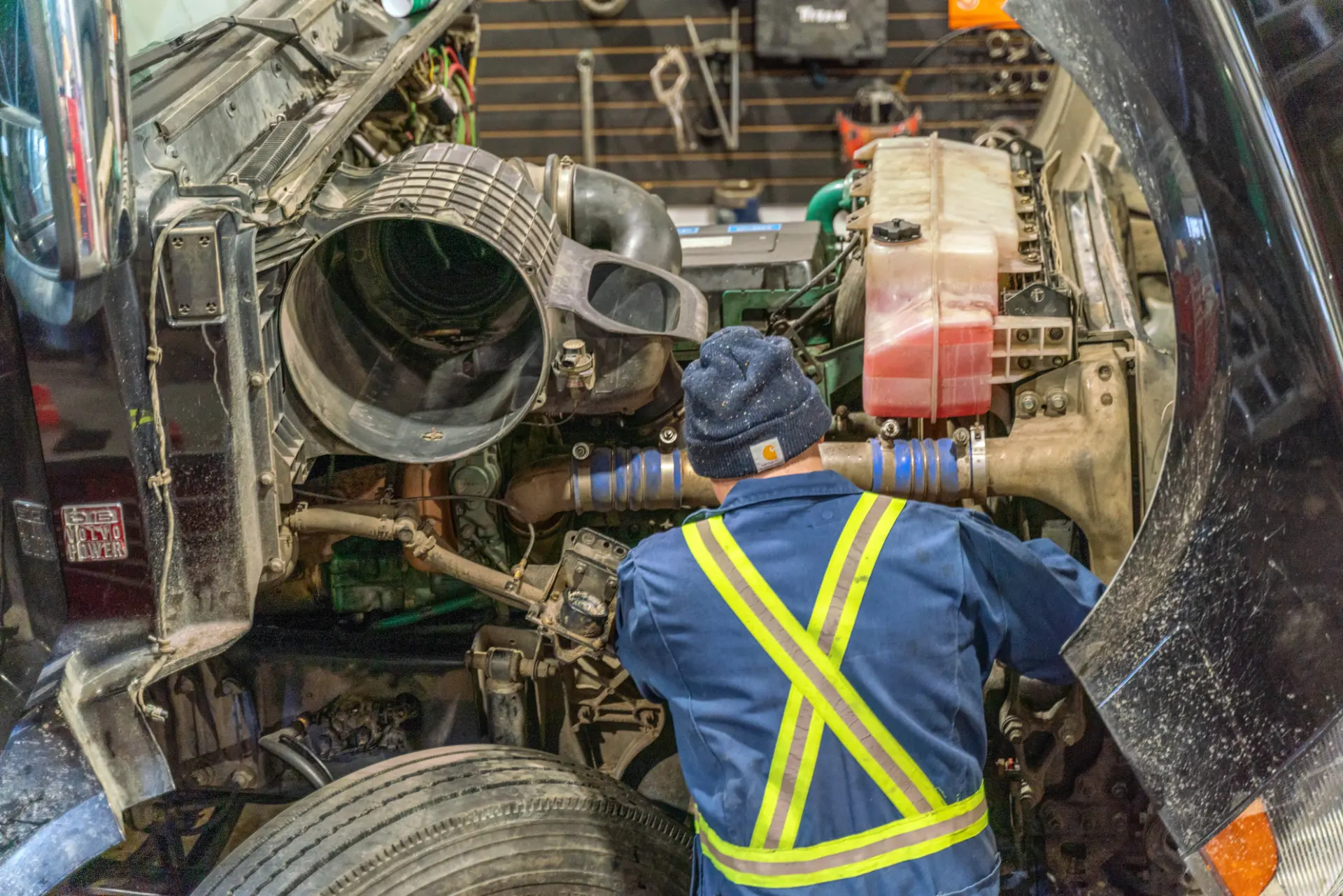
Diesel Cranks but Won't Start: Where Is the Fault?

When a commercial diesel engine cranks at normal speed but refuses to fire, operators need to isolate the fault quickly to prevent costly towing and freight delays. Because the starter motor and primary battery circuits are functioning enough to turn the engine over, a "crank-no-start" condition typically points to fuel delivery failures, electronic module faults, cold-weather system breakdowns, or a loss of mechanical compression.
Finding the exact cause requires systematic troubleshooting. Modern High-Pressure Common Rail (HPCR) engines like the Detroit DD15, Cummins X15, PACCAR MX-13, and Volvo D13 rely on precise electronic conditions to authorize injection. This guide breaks down exactly how to diagnose a diesel truck that cranks but will not start, ensuring you know when a quick mobile fix is possible and when you need comprehensive diesel repair in Edmonton.
What Causes a Crank-No-Start Condition?
A crank-no-start condition happens when the engine physically rotates via the starter motor, but combustion does not occur. Unlike a dead battery or seized starter, the engine is trying to run but lacks one of the vital components of diesel combustion: adequate fuel pressure, electronic injection authorization, sufficient cranking speed, or mechanical compression. Identifying which of these four systems has failed is the first step in emergency truck repair.
Step 1: The 60-Second Cab and Exhaust Triage
Before connecting diagnostic equipment, operators can narrow down the fault using basic sensory indicators. Knowing the difference between fuel starvation and starter or alternator failures in commercial trucks helps avoid wasted diagnostic time.
Listen for the electric lift pump priming when you turn the key to the "ON" position without cranking. On engines equipped with an electric transfer pump, it typically runs for a few seconds. Next, observe the dashboard indicators. On most platforms, the Check Engine or Stop Engine lamp illuminates briefly at key-on as a bulb check; if the dash stays dark, the Electronic Control Module (ECM) may lack power or ground.
Watch the tachometer while cranking. On trucks that display cranking RPM on the dash gauge, a needle that stays pinned at zero can indicate that the ECM is not receiving a Crankshaft Position Sensor (CKP) or Camshaft Position Sensor (CMP) signal. Finally, check the exhaust stack. No smoke and no raw diesel smell usually indicates that little or no fuel is being injected into the cylinders. Conversely, white or grey smoke with a raw diesel smell suggests that unburned fuel is entering the cylinders, pointing to insufficient heat or compression for ignition.
Step 2: Electronic and ECM Faults
Modern electronic diesel engines do not fire injectors mechanically. The ECM must verify a strict chain of electronic conditions before pulsing the injectors. The sequence flows from ECM power, to the 5V sensor supply bus, to crank/cam signals, synchronization, rail pressure, and finally injector command.
Even if the starter spins the engine briskly, corroded battery interconnects or a poor dedicated ECM ground can cause voltage at the module to sag while the starter draws heavy amperage. The engine continues to crank, but the ECM can brown out or reset. Additionally, the ECM requires synchronized crankshaft and camshaft position signals to determine engine speed and piston position before timing fuel injection. If no RPM data appears on a diagnostic scan tool while cranking, Detroit Diesel troubleshooting manuals recommend testing continuity and resistance across the sensor harness pins to isolate an open wire or short before replacing the sensor.
Replacing sensors blindly is a costly mistake. A sensor may produce a valid signal, but damaged wiring or a corroded connector can prevent that signal from reaching the ECM. On many heavy-duty platforms, including Cummins, Detroit, and PACCAR engines, a 5V reference bus is shared across multiple engine sensors. If an auxiliary sensor such as an oil pressure or boost sensor shorts internally, it can pull down the shared 5V network, disrupting the fuel rail pressure sensors and preventing the truck from starting. Proper truck diagnostics and electrical repair in Edmonton focuses on circuit testing rather than parts swapping.
Step 3: Fuel Delivery Systems
High-Pressure Common Rail (HPCR) systems require sufficient supply and rail pressure before the ECM will authorize injection. Minimum starting thresholds vary by engine platform; for example, the Detroit Diesel DD15 Troubleshooting Manual specifies that rail pressure during cranking must exceed 150 bar (approximately 2,175 PSI) for the engine to start, while the low-pressure pump builds 30 to 40 PSI within 20 seconds of cranking.
Air intrusion is another frequent culprit. If a truck starts briefly and dies, or cranks without firing after sitting overnight, air may have entered the low-pressure fuel system and allowed fuel to drain back to the tank. Cracked water separator collars and worn O-rings on primer pumps are common failure points. When priming a fuel system or troubleshooting a no-start, avoid cranking a heavy-duty starter for more than 15 to 20 seconds at a time, and allow roughly two minutes between attempts for the starter motor to cool down.
If the low-pressure side functions, high-pressure leaks could be to blame. If a Pressure Limiting Valve (PLV) weeps back to return, or if injectors suffer excessive internal leakage, the rail will never reach the required starting pressure.
Step 4: Cold-Weather Starting Problems
Winter operating conditions in Alberta place heavy strain on starting, charging, and fuel systems. Cold temperatures commonly trigger three distinct crank-no-start failure modes:
Diesel Fuel Waxing: Diesel fuel does not freeze solid like water. Instead, dissolved paraffin waxes precipitate out as solid crystals when fuel cools below its Cloud Point. These microscopic crystals rapidly plug fine modern HPCR fuel filters, starving the high-pressure pump. Simply parking a gelled truck inside a heated bay can still take hours for solidified wax in the tanks and filters to reliquefy without filter replacement and fuel treatment.
Low Cranking Speed: As diesel diagnostician Albin Moore notes in Vehicle Service Pros, many diesel engines require a cranking speed of around 150 RPM to compress air rapidly enough to reach auto-ignition temperature. Thickened cold oil and cold-soaked batteries can slow cranking speed enough that the engine turns over audibly without building sufficient heat to fire.
Intake Pre-Heat Failures: Many heavy-duty Class 8 engines rely on an intake air grid heater or glow plug system for cold starts. If a heater relay, solenoid, or high-amperage fuse fails, sub-zero intake air loses too much heat to the cold cylinder walls during compression to ignite the injected fuel.
Because cold weather exposes underlying weaknesses in batteries, starters, and fuel filtration, scheduling seasonal preventive maintenance before temperatures drop helps fleets avoid winter roadside emergencies.
Step 5: Mechanical Compression and Restrictions
If fuel rail pressure meets specification, electronic sensors are synchronized, and pre-heat systems work, the underlying issue may be mechanical. Worn piston rings, leaking head gaskets, or "cylinder wash" (where repeated failed cold-start attempts introduce unburned diesel that washes the sealing oil film off cylinder walls) can reduce compression below what is needed for ignition. Restricted air filters or an obstructed exhaust and aftertreatment system can also prevent air from flowing freely through the engine.
Emergency Roadside Truck Repair Along Highway 16 Near Edmonton
Fleetgo Heavy Duty provides 24/7 emergency roadside truck repair along Highway 16 near Edmonton, dispatching mobile units across a 100 km radius that includes Spruce Grove, Stony Plain, Sherwood Park, Fort Saskatchewan, and St. Albert (Phone: 780-455-8131). Common Highway 16 emergencies resolved on-site include winter fuel gelling, filter replacement, air intrusion bleeding, battery boosts, and sensor wiring repairs. Utilizing on-site roadside repair for electrical, sensor, and fuel filter faults helps fleets avoid heavy towing expenses and reduces downtime. Towing is generally reserved for cases where mobile diagnostics confirm a major internal failure, such as a failed high-pressure fuel pump or internal engine damage.
Commercial Truck Electrical Repair in Edmonton
For commercial truck electrical repair in Edmonton, Fleetgo Heavy Duty isolates the root cause of no-start conditions by load-testing battery banks, measuring voltage drops across starting and ECM circuits, and tracing sensor wiring faults rather than guessing with replacement parts. Cold temperatures and road moisture place heavy demands on commercial electrical systems, making weak batteries and corroded connections a leading cause of winter roadside callouts. By relying on pin-out continuity testing, technicians can pinpoint corroded harness splices or shorted sensors pulling down the 5V reference bus, helping prevent repeat breakdowns on the highway.
On-Site Diesel Truck Diagnostics in Edmonton
Fleetgo's mobile service trucks bring on-site diesel truck diagnostics in Edmonton directly to client yards, loading docks, and highway shoulders across a 100 km radius. Before replacing components, mobile technicians connect diagnostic software to read live ECM parameters during a crank-no-start callout. This includes checking active and inactive fault codes, verifying cranking RPM and cam/crank synchronization, comparing commanded versus actual fuel rail pressure, and running electronic relative compression tests to identify low-compression cylinders without disassembling the engine on the roadside.
24/7 Heavy-Duty Truck Roadside Assistance in Edmonton
Fleetgo Heavy Duty operates 24/7 heavy-duty truck roadside assistance in Edmonton, supporting light, medium, and heavy-duty commercial trucks and trailers year-round. If you need immediate roadside truck assistance in the Edmonton region, direct dispatch is available at 780-455-8131. Every mobile call is backed by Fleetgo's full-service Edmonton facility featuring three drive-through bays. If an after-hours roadside diagnostic reveals that a major fuel system or engine repair is required, the truck can transition directly to the in-shop team without third-party repair handoffs.
Resolving Crank-No-Start Breakdowns Promptly
Diagnosing a diesel engine that cranks but refuses to start requires a systematic approach and accurate diagnostic data. By checking initial cab and exhaust indicators, testing ECM power and sensor circuits, verifying fuel delivery pressure, and accounting for cold-weather factors, operators and technicians can isolate the root cause without unnecessary parts replacement. Whether a breakdown calls for mobile roadside service or in-shop diagnostics in Edmonton, following a structured troubleshooting sequence helps get commercial trucks back on the road safely and efficiently.
More Articles

DPF Regen Keeps Failing: What Could Be Causing It?


Contact FleetGo
Get in touch with Fleetgo today to request a quote or to schedule in-shop or mobile services in Edmonton & the surrounding area! Our mobile service extends to a 250km radius around Edmonton for emergency roadside assistance & mobile truck & fleet repairs, including Sherwood Park, Spruce Grove, Fort Saskatchewan, St. Albert, Stony Plain, along Highway 16, & more!